How a rural community in drought-prone northern Haiti built climate resilience
From Hurricane Melissa's deadly floods in October 2025 to recurring droughts in the north, Haiti has been plagued by extreme events that have pushed farmers to build an irrigation network amid government inaction.
It takes a short, white-knuckle motorcycle ride to get to Guillaume Josaphat’s rice fields from Ouanaminthe, a Haitian market town at the border with the Dominican Republic, known as Wanament in Creole and Juana Méndez in the neighboring country. Within minutes, the scenery changes dramatically: the muddy, garbage-strewn track in the slums leads to a flat, verdant countryside as Josaphat, a 60-year-old farmer, expertly swerves around wide puddles of turbid water or drives right through them when they seem shallow enough.
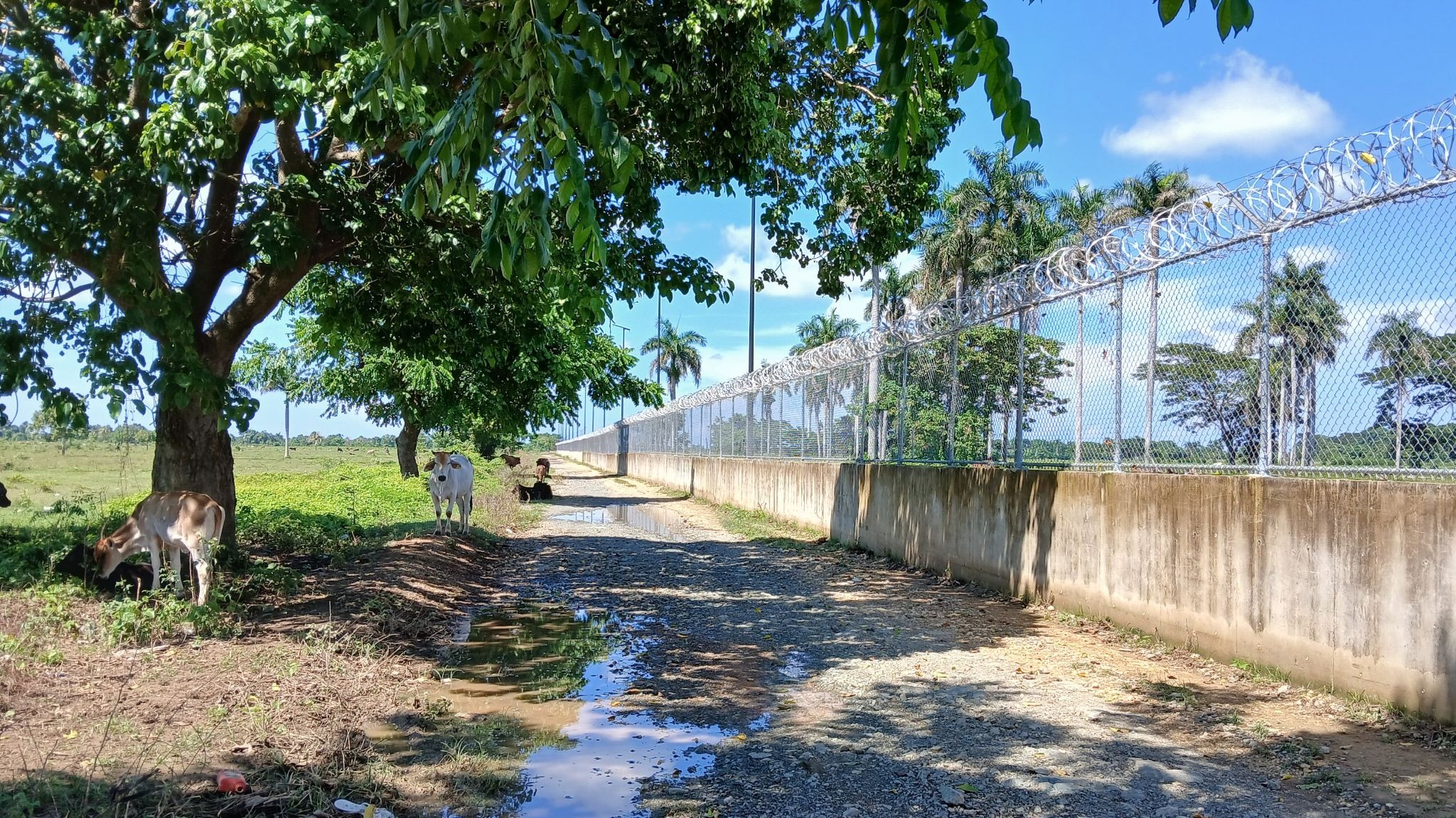
On the left side of the gravel track, as far as the eye can see, the landscape is a patchwork of rice paddies, cornfields, banana groves, mango or avocado trees, and herds of cattle, separated by narrow irrigation ditches overflowing with clay-colored water. On the right side, the gray, monotonous expanse of the Dominican Republic’s border wall, topped by a metal fence and barbed wire, whose construction started in 2021 at President Luis Abinader’s behest, does what it was intended to do — to divide the island and keep unwanted Haitian immigrants out.
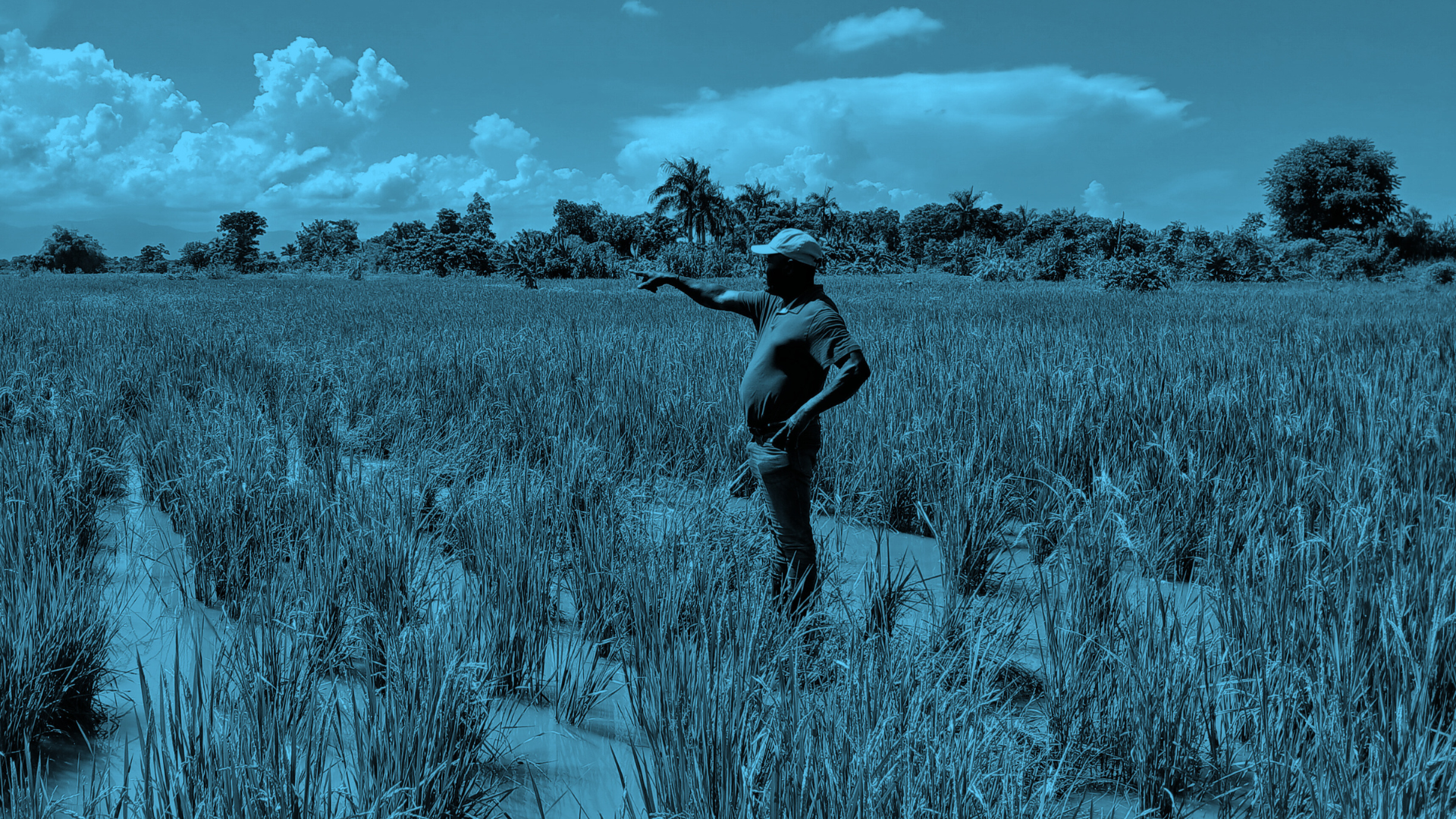
One Sunday in October, Josaphat parked his motorbike under a tree and started touring his 10-acre farm, which he has owned since 1997. “This is the Maribahoux plain — one of the most fertile farming areas in Haiti,” said Josaphat in Creole as he strode briskly across his fields. And yet, just two years ago, this lush 30,000-acre agricultural region was in serious decline due to the increasingly dry climate.
In the past, the two annual rainy seasons — from April to June and then from September to January — were reliable in that corner of northeastern Haiti, allowing peasants to plan field work accordingly. But over the last two decades, rainfall has become increasingly erratic, while unusually long and intense periods of drought have appeared. “It started in 2006: there was no rain that year,” Josaphat recounted. “Climate change hit us very hard. This area was becoming a desert. We were desperate,” the farmer said. “The creeks were drying up. We couldn’t find water for our animals.”
His fellow farmers readily agree. “When I was young, we had sufficient rain to grow plenty of food. But over the years, it got harder and harder, and our harvests often failed,” said Joseph Denis, 58, a peasant from the neighboring village of Ferrier, another settlement in the Maribahoux plain. And for the region’s peasants, drilling wells was not a practical option, given the cost of pumps and fuel.
Climate data confirms the peasants’ observations. In a March 2023 report, the World Food Programme asserted that Haiti was undergoing “a multi-year cycle of unseasonably dry and hot conditions, revealed by satellite time series,” with “the north-eastern parts of the country being more severely impacted. University experts agree that the change in rainfall patterns observed in recent years in that part of the island is, in all likelihood, a consequence of climate change. One of the effects of this global phenomenon caused by greenhouse gases being released into the atmosphere by human activity is “an increase in the intensity and frequency of extreme weather events” such as “droughts and floods,” in addition to “rising global temperatures that are affecting agriculture,” said Pierre Paul Audate, assistant professor in the Department of Geography at the University of Montreal.
Haiti has been faring badly. The Caribbean island nation “is one of the most vulnerable countries” to the climate crisis, said Evens Emmanuel, vice-rector for research and innovation at Quisqueya University in Port-au-Prince, citing various international assessments.
The country’s vulnerability had tragic consequences once again when Hurricane Melissa struck in late October 2025. Unlike neighboring islands, Haiti was not directly hit by the center of that exceptionally powerful storm, which made landfall in Jamaica on October 28 as a category 5 hurricane on the Saffir-Simpson scale — with winds blowing at 185 mph, or 295 km per hour —, and in eastern Cuba the next day, as a category 3 hurricane. But the heavy rainfall that battered southern Haiti for several days in late October, as the major hurricane stalled over the Caribbean Sea, was enough to cause widespread destruction in that part of the island. According to official data, which have not been updated since November, at least 43 people perished in the floods caused by Hurricane Melissa in Haiti and 13 were unaccounted for.
“So far, there is no final official death toll,” said Quetya Aubin, a scientific journalist, blaming “the situation in Port-au-Prince,” the country’s capital: Haiti has been mired in an ever-worsening political crisis for years, compounded by extreme gang violence in much of Port-au-Prince and several regions in the country. As a result, “getting to the areas affected by the hurricane isn’t easy,” added Aubin, who is a member of Quisqueya University’s investigative unit on climate change.
More than half of the known hurricane victims died in Petit-Goâve, a coastal town 40 miles west of Port-au-Prince. In the early hours of October 29, La Digue river suddenly burst its banks and flooded the neighborhoods of La Digue and Borne-Soldat, sweeping away many homes and cars. “It was about 1 or 2 am,” Nikenson Saintil recounted. “We heard loud noises that woke us up, and the water was already surrounding our house,” said the 36-year-old public relations officer of a local charity, the Association of Seminarians for the Development of Petit-Goâve.
About 150 homes were destroyed in that area where “some 700 families” used to live, Saintil said. “The hurricane wrecked our house and filled it with mud,” said Mattania Simon, 24. A medical biology student, Simon used to live in a single-storey house in Borne-Soldat, some 100 meters away from the river banks, with her parents, her siblings and one cousin. “That’s far from the river. We never thought we were at risk of flooding there,” she said.
Yet, on that fateful night, within a few minutes, Simon found herself “neck-deep in dirty water.” She made it alive thanks to her younger brother’s quick thinking: the young man helped the family scramble up to the roof of the house just before it was too late. However, he did not manage to save the 22-year-old disabled woman who lived with them. “She drowned,” said Simon. “About 30 people perished in Petit-Goâve, 26 in Borne-Soldat alone,” Saintil asserted.
The student said her family “lost everything” in the disaster: the house, which they had rebuilt after the January 12, 2010 earthquake that destroyed much of Port-au-Prince, Simon’s books and learning material, her mother’s business. The family is now separated: Simon’s parents and brother are staying with relatives in Léogâne, while she and her cousin have remained in Petit-Goâve and have been surviving in a squalid camp for displaced people in the town hall yard. “I don’t have a roof over my head. We get soaking wet every time it rains,” she complained.
“Forty-three families are staying there. That’s about 160 people, including 55 children,” said Saintil, whose charity has been providing key support to hurricane survivors in Petit-Goâve. “They’ve been homeless for more than two months and they have nowhere to go,” the public relations officer lamented, denouncing the “degrading and unsanitary conditions” they have been living in, sharing only one shower for everybody.
About “a dozen” more families made homeless by the hurricane have sought refuge in a neighborhood called Anba Fò, where they spend the nights “out on the streets, without any protection,” said Nancy Desséjour Policier, the head of the Union for the Development and Respect of Haitian Women, a women’s organization in Petit-Goâve.
On December 29, disaster victims held a peaceful demonstration in front of the town hall, demanding that public authorities relocate them to a place where they can live with dignity.
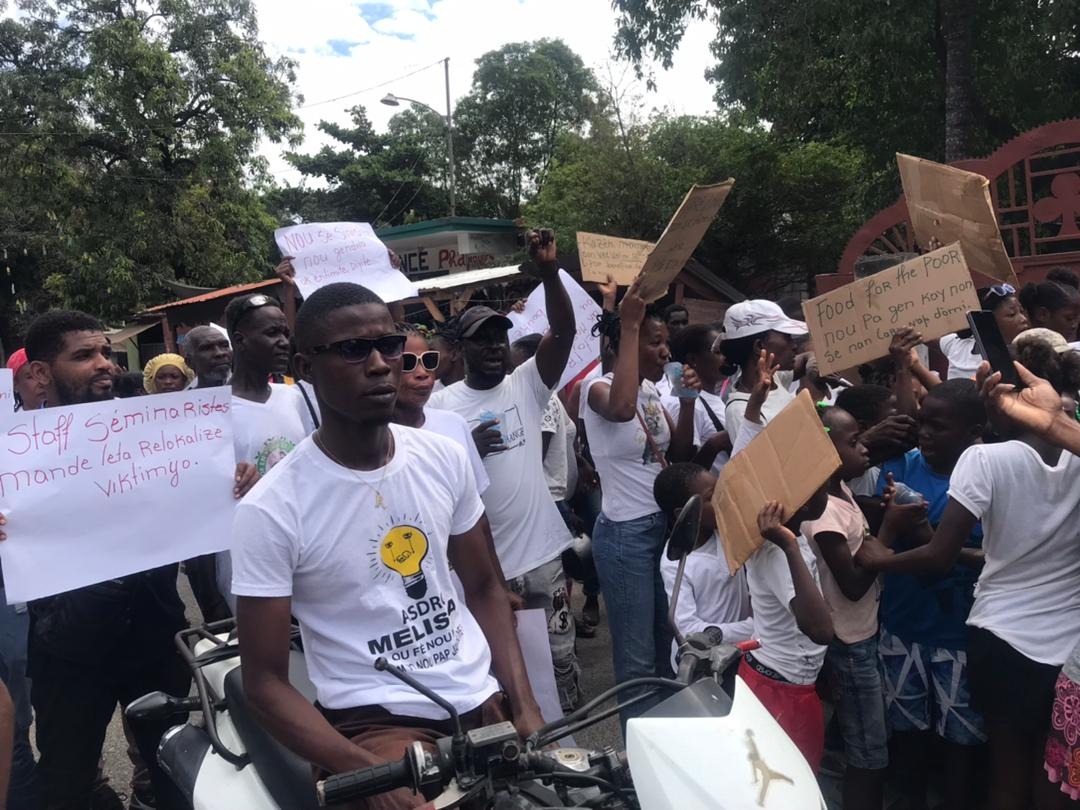
Hurricane Melissa victims protest to demand relocation and dignified living conditions .Photo provided
But their pleas have fallen on deaf ears so far.
“There are still many urgent humanitarian needs: decent housing, access to education for children, income-generating activities for parents, medical assistance, clothing, food, and drinking water,” lamented Desséjour Policier. The NGO leader said that “much of the devastation wrought by the hurricane is still visible,” nearly three months after the event: Many damaged roadways and homes need repairing and some areas are “still covered in mud”.
Even in parts of Haiti that were less acutely affected by Hurricane Melissa, the aftereffects of the storm are still being felt. Flooding was severe in Les Cayes, the largest city in southern Haiti, “but it’s a recurring problem here,” said Sarah Cécina Joseph, a local business owner, who noted that there was little lasting damage in her city.
However, food prices have increased significantly due to the devastation caused by heavy rains in agricultural areas. “Many banana trees did not withstand the wind, and now plantains are a lot harder to find on the market,” Cécina Joseph explained. “It’s mostly the women who have noticed that, since we’re the ones buying food.” The price of a bundle of two or three plantains — a staple in Haitian cuisine — has tripled in Les Cayes, to 250 gourdes, or $2.
According to the United Nations, Hurricane Melissa displaced more than 16,000 people to temporary shelters in Haiti. The storm affected “1.25 million people in 59 municipalities” in the country, the UN said in a November 6 report, adding that “up to 90%” of crops had been destroyed in some areas, making life more difficult for members of “communities already severely affected by food insecurity”.
This is definitely the case in virtually every district around Petit-Goâve, Aubin asserted. “Floods and soil erosion” are some of the main environmental hazards in that region and in other parts of the country, the scientific journalist added, reminding that several hurricanes caused far deadlier inundations in the past decades in Haiti: The impacts of hurricane Jeanne, in the northern city of Les Gonaïves, in 2004, and of hurricane Matthew, in the country’s south, ten years ago, were “way worse than what we saw with Melissa,” she said.
Despite the devastating floods that can be caused by hurricanes, Haiti faces the risk of “absolute water scarcity” with a “highly uneven distribution” of water availability across this large mountainous island, Emmanuel added. The threat of widespread water shortages is linked to the country’s growing population, the Quisqueya University academic noted.
The northeastern region of the country, “an agricultural powerhouse with a lot of cattle farming,” is at risk of recurring droughts, Emmanuel warned, adding that “high groundwater salinity” in that part of the country means that underground water is mostly “unfit for irrigation”.
“Water shortages are made worse by deforestation,” said assistant professor Audate. A native of northeastern Haiti, the Montreal-based lecturer pointed out that he has observed firsthand “the decrease in water flow” affecting local streams.
The “Unstoppable” Ouanaminthe Canal
So about fifteen years ago, as droughts ruined harvest after harvest, peasants in the Maribahoux plain called for an irrigation canal network to be built. That system would be supplied with water from the Massacre River — or Río Dajabón in Spanish —, the river that meanders along the border between Haiti and the Dominican Republic in that part of the island, all the way to the Atlantic coast in the north. The project was initially supported by the Haitian government. Work began in 2013 but progressed slowly and intermittently as state subsidies dried out, squandered by corrupt officials, as many locals believe. The assassination of President Jovenel Moïse in July 2021 plunged the country into renewed turmoil, and construction stopped altogether.
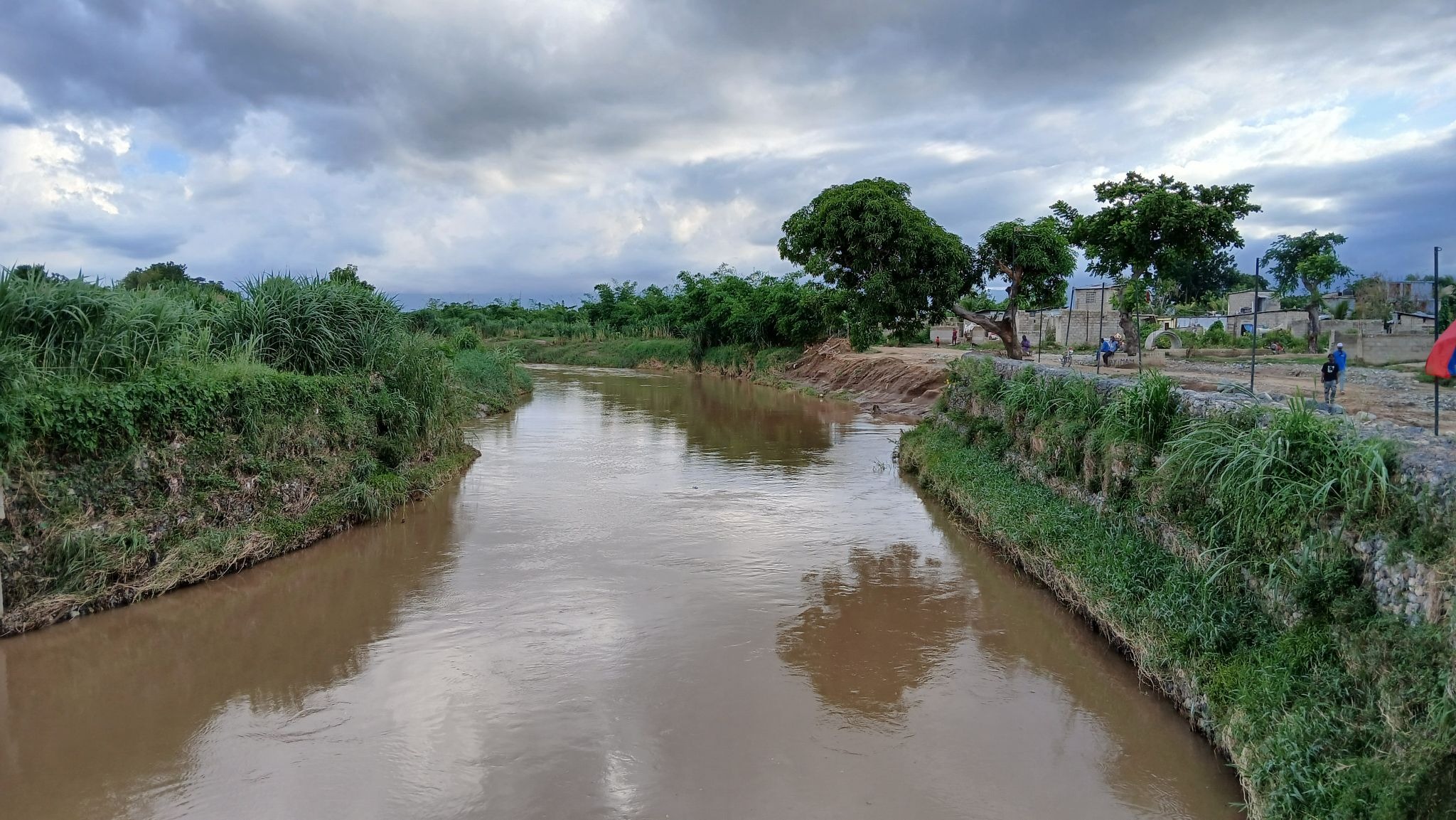
Eventually, farmers’ associations, representing some 5,000 peasants in the region, decided that community members should roll up their sleeves. They set out to complete the infrastructure themselves: a 1.7-mile-long masonry structure that carries water from the river to the Maribahoux plain, where it branches out into a dense network of secondary canals and ditches.
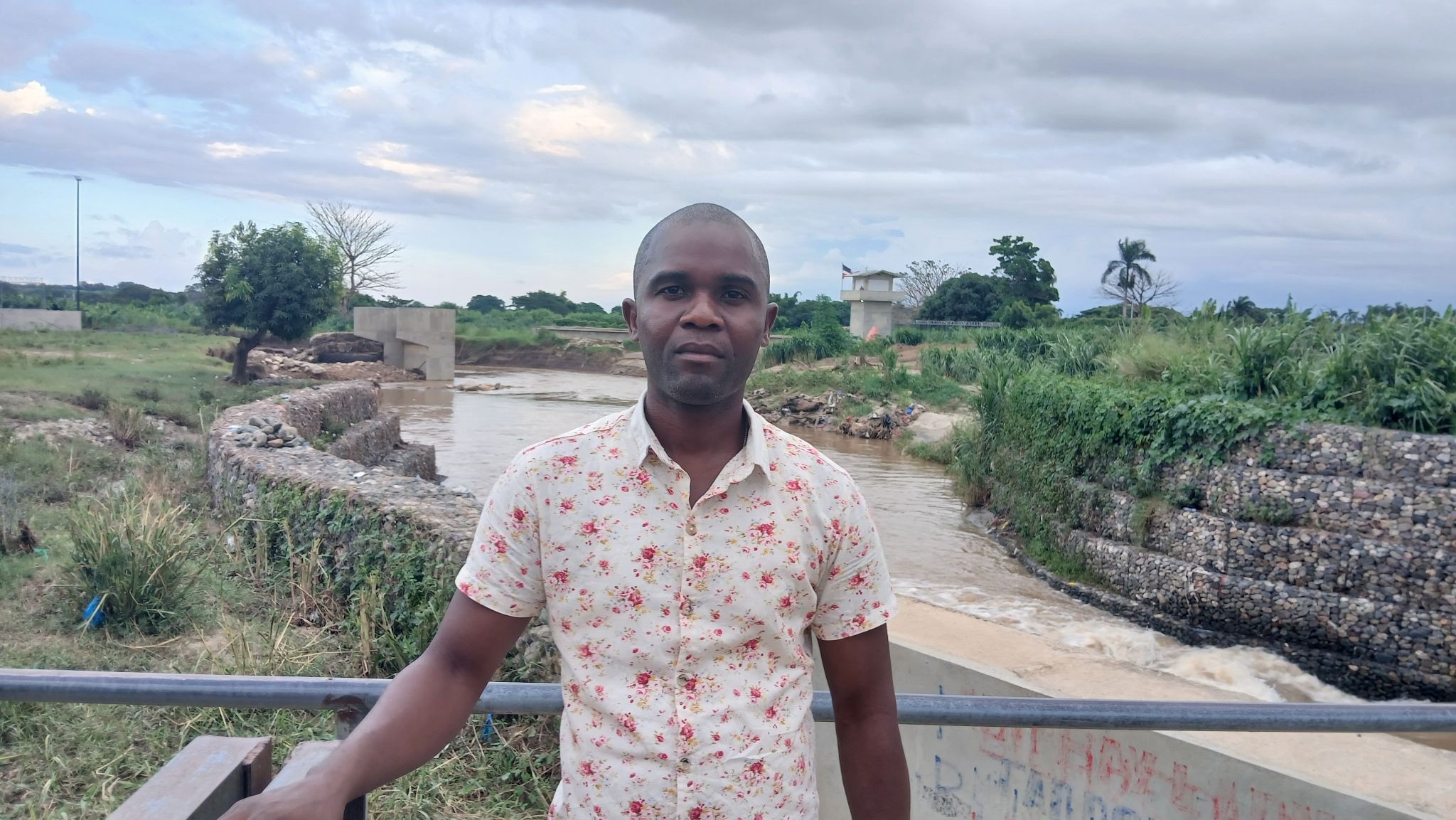
“In August 2023, we started digging. It was a collective effort: thousands of people volunteered,” explained Mackendy Josaphat, one of Guillaume Josaphat’s sons, his voice brimming with pride. “I took part, like everyone else: I did ironwork and masonry,” said the 38-year-old farmer, who was elected chairman of the canal’s management committee in March last year.
The project was to be funded by local peasants, but it also received substantial support from Haitians in the diaspora, who avidly followed the progress of this “konbit” — a traditional form of communal work in rural Haiti, similar to a “convite” in the neighboring country.
The construction of the canal also further strained the already fraught relations between Haiti and the Dominican Republic. The government of the latter country contended that the Ouanaminthe irrigation project violated the terms of a 1929 treaty and increased the risk of water overuse and flooding on the banks of the Massacre River. In protest, Dominican authorities closed the border for several weeks. This unilateral move stifled business not just in Ouanaminthe, but also in the Dominican city of Dajabón, just across the river. The twin cities’ economy had been heavily reliant on cross-border trade for many years.
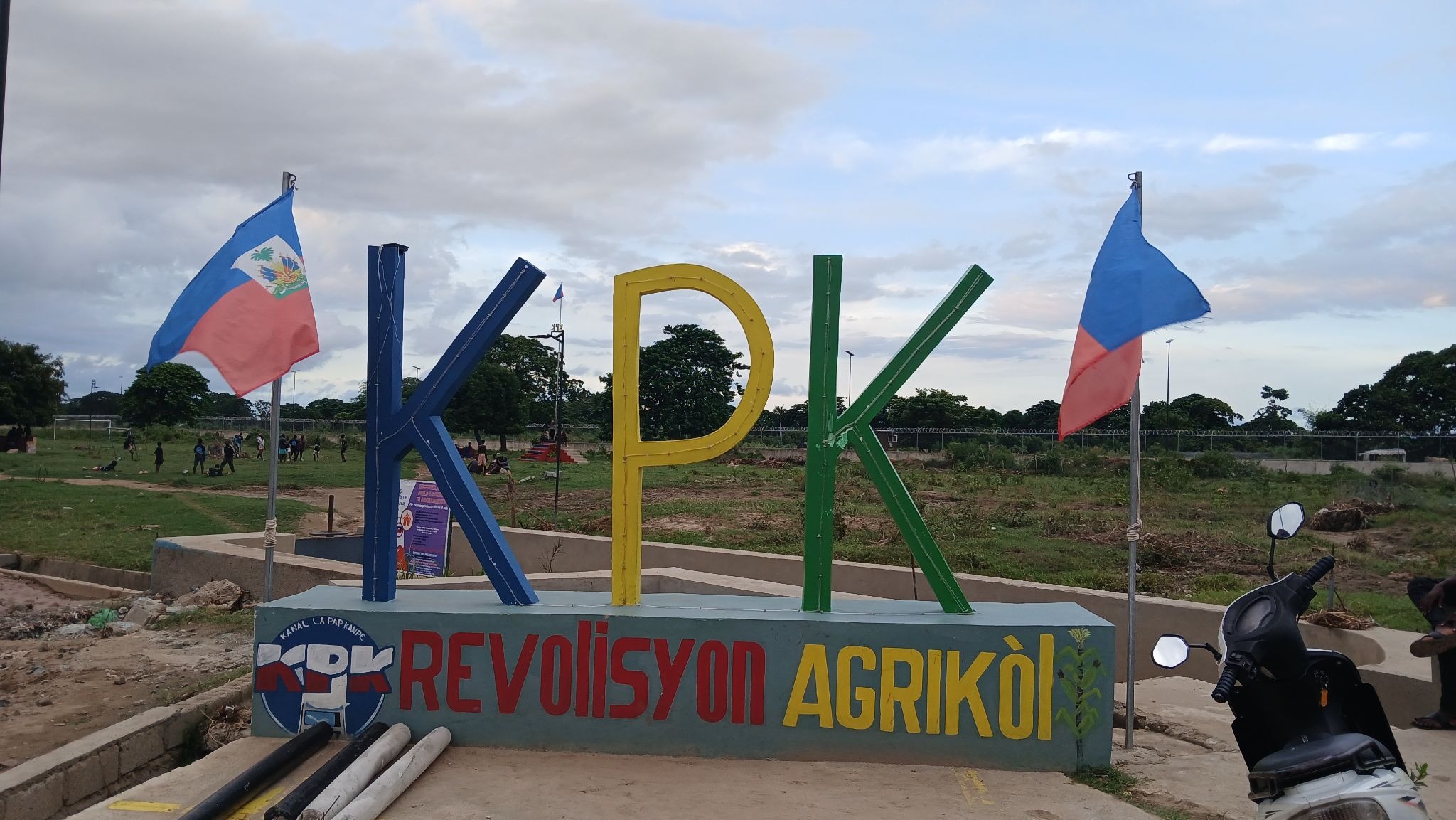
But the diplomatic standoff also whipped up patriotic sentiment in Haiti, while the government refrained from interfering with the canal issue. “The inappropriate behavior of the Dominican president awakened the Haitian spirit,” said Jacques-Sauveur Jean, owner of a 120-acre rice farm in Mérande, a hamlet near Ferrier. Defiant Maribahoux farmers dubbed their irrigation project KPK, the acronym for “Kanal Pap Kanpe” (“The Unstoppable Canal,” in Creole).
“The Dominican Republic already has eleven irrigation canals on its side of that river,” Emmanuel noted. Therefore, “one or two canals being built in Haiti are really not that big of a deal,” the Quisqueya University researcher added, echoing a widespread opinion in his country about shared water use on both sides of the border.
In March 2024, water from the Massacre River started flowing into the fields of the Maribahoux plain, drastically improving farmers’ lives at once. “Before, we would harvest at most 4 tons per acre per year, not to mention the crop failures,” said Jean. “With irrigation, we are able to produce 4 to 7 tons per acre,” the 58-year-old businessman added.
A famous “konpa” music singer — known as Jackito — and a former senator, Jean has built a canal-themed leisure facility near his grain factory. It boasts a bar with an outdoor pool, several beach huts and a fountain in the middle of a park with coconut and banana trees. “T-Kanal Park celebrates the achievement of completing the canal,” the entrepreneur said.
“Now I have three crops a year, whereas we used to harvest just once,” said Rochenel Paulimus, 50, owner of 10 acres of rice fields and tree plantations in Ferrier. Thanks to his better income, the farmer was able to improve his house and to buy a motorcycle for 150,000 gourdes (approximately $1,150) in one payment. “I used to own just one bicycle,” he said.
A father of eight children, the younger six of whom still attend school in Ouanaminthe, Paulimus can now pay his children’s tuition fees in October, at the start of the term. Until two years ago, his children could only start classes in January, so they missed the first three months of the term every year. “I just couldn’t afford school before the rice harvest,” he confided.
And since rice has become much more abundant, its price has fallen by up to 30%, benefiting the whole community. A 50-kilogram rice bag “now costs 21,000 gourdes ($160), down from 31,000 before the canal,” said a very pleased-looking Paulimus.
The success of the KPK Canal in Ouanaminthe is inspiring other grassroots projects in the region and across the country. Outside of Malfety, a hamlet near the coastal town of Fort-Liberté, located half an hour’s drive from the border, a one-mile-long structure is being built by local farmers using the “konbit” method once again. That infrastructure is dubbed KPR, or “Kanal Pi Rèd,” Creole for “The Stauncher Canal”. “We are going to irrigate more than 18,000 acres of farmland,” engineer Claude Louis said enthusiastically.
But the site was very quiet that morning, on a sunny Wednesday in October. “The project has been at a standstill for several days because we are short of sand, gravel, and cement,” the project coordinator conceded, looking slightly crestfallen, but still optimistic. Work resumed a few weeks later, and progress on the Malféty Canal has been documented on social media since then.
While they’ve done most of the work by themselves so far, the Maribahoux peasants may be getting some much-needed help soon. In the farming areas around Les Cayes, in southern Haiti, agricultural experts have helped increase yields “by introducing more efficient techniques, but also new crop varieties,” said Gaël Pressoir, scientific director at the Haitian Center for Innovation in Biotechnology and Sustainable Agriculture, an institution known under its French acronym, CHIBAS. The project has been possible with government funds and international aid. “We’re hoping to bring that stuff to the northeast, to support the communities there and help them make the most of these newly irrigated areas.”
No doubt the Maribahoux farmers will welcome any support they can get. For starters, the infrastructure needs to be consolidated.
“We still need to build reservoirs, install floodgates to regulate the water flow, and gabions to protect the embankments from erosion,” said Mackendy Josaphat, looking at the Massacre River from the monument erected in the outskirts of Ouanaminthe by the canal builders to commemorate this collective achievement. “It’s the rainy season and maintenance work needs to be done. The state promised us 500 million gourdes ($3.8 million), but we haven’t received one dime yet.” A local representative of Haiti’s agriculture ministry in the Northeast department was contacted three times, but did not respond.
And maintaining the infrastructure is not enough. It also needs to be managed fairly in the long run so that the farmers whose fields are at the end of the line can receive water too. “I’ve seen irrigation systems where everyone fights and farmers literally walk around with guns in their belts,” Dr. Pressoir asserted. “This management aspect is crucial, especially in a country that doesn’t have an effective government to run that kind of thing.”
So far, water sharing does not seem to be a major issue for the Maribahoux farmers. They do have a very pressing problem, however. “Now, we have water but we need mechanical equipment,” said Guillaume Josaphat, while touring his rice fields. He stopped and greeted a group of peasants working on the other side of a row of cassava shrubs: one of them was playing drums while another one was busy tilling a field with a plow pulled by two white oxen. “These cows will plow one hectare of land in about ten to fifteen days, but with a tractor, we would be able to manage four hectares per day,” he commented.
“I harvested one field two months ago but I still haven’t plowed it because I don’t have a tractor,” his friend Paulimus complained. “And even if I could rent one, we don’t have enough farm roads, so vehicles can’t get everywhere,” he added.
Astonishingly, Maribahoux farmers currently have less access to machinery than they used to. “In the past, Dominican contractors would cross the river with their combine harvesters and rotary tillers,” said Dr. Pressoir. But now the border wall prevents that kind of transnational cooperation. And Haitian peasants are having a hard time completing field work manually because “there’s a labor shortage in agriculture in Haiti,” the agronomist added. “Young people don’t want to be farm workers,” so most farmers are “in their 50s or 60s or even older,” he noted.
“So there is a lot of work for the farmers’ organizations in the Northeast to find solutions to all these issues,” Dr. Pressoir said. But, compared to the way the situation was before the irrigation canal was built, “these are great challenges to have to deal with.”
A source of pride for many Haitians, the Maribahoux irrigation network is a prime example of “environmental restoration, which means adopting sustainable natural resource management practices to tackle deforestation and soil erosion,” said Aubin, the Quisqueya University science researcher. However, to strengthen Haiti’s resilience to climate change, “a comprehensive approach is needed,” she pointed out.
Aubin advocates a long list of measures, ranging from “massive reforestation programs that prioritize species suited to the local climate,” to building environmental awareness in “schools and communities,” to “protecting mangroves and coastal reefs,” and “discouraging the use of charcoal by households”.
Specifically, much of the damage caused by hurricane Melissa “could have been avoided if preventative steps had been taken, such as regular riverbed dredging, proper drainage system maintenance, and better management of high-risk areas,” said Desséjour Policier, the women’s NGO leader in Petit-Goâve.
“There’s a lot of work in the environmental field alone,” said Aubin. “Haiti badly needs proper policy makers.”