Quiz: How much do you know about co-ops in Puerto Rico?
During Co-op Month, 9 Millones is teaming up with CoopERA to put your knowledge of Puerto Rico’s cooperative movement to the test
What do a group of women coffee farmers in the mountainous region, a cycling collective in Río Piedras, and professionals offering research and consulting services have in common?
Although they seem very different, they all have something in common: they have organized themselves into co-ops.
When we think of cooperativism in Puerto Rico, the first thing that likely comes to mind is credit unions (financial cooperatives). However, Puerto Rican cooperativism is present in many other aspects of our daily lives: ranging from agriculture and housing to manufacturing, healthcare, and professional services.
As of 2025, Puerto Rico had 121 cooperatives of various types, according to data from the Puerto Rico Public Corporation for the Supervision and Insurance of Cooperatives (COSSEC, in Spanish). As the name suggests, these cooperatives of various types are spread across all of the country’s economic sectors. This figure exceeds the 97 credit unions present in the archipelago.
Although their purposes vary widely, they all have adopted a cooperative organizational model, in which people voluntarily come together to meet common needs through a jointly owned and democratically controlled enterprise.
Members can organize to support each other in their work, to secure their own employment and decision-making power; as users or consumers of goods and services, to obtain benefits by purchasing or consuming collectively; or by combining both approaches. As of October 2025, among the various types of cooperatives, 59 were worker cooperatives, 55 were user or consumer cooperatives, and seven were mixed cooperatives.

This Cooperative Month, CoopERA and 9 Millones invite you to test how much you know about this part of the Puerto Rican economy.
Questions
Choose the correct answer
- Which of these cooperatives operate in the agricultural sector?
- COOPPORCI
- Orgánica Madre Tierra
- Vainilla Coop
- All of the above
Agriculture is one of the economic sectors where we find various co-ops in Puerto Rico.
2. Which co-op would you contact to facilitate conversations and learn through games?
- CoopSEI
- Coop Yerba Urbana
- Caribana Coop
- La Ventana de Cantera Coop
Professional services are also part of Puerto Rico’s cooperative landscape. These examples show that professionals from different fields can organize their work collectively through a cooperative.

3. In which of these regions is there a group of women coffee farmers that have organized into a cooperative?
- Metropolitan area
- Southern region
- Central mountainous region
- Northeastern region
Cooperative organizing also allows people who participate in a productive sector to join forces and address common needs. The experience of women coffee farmers is one example of how this collective organization is present in Puerto Rican agriculture.
4. What is the name of the cycling collective that formed a co-op in Río Piedras?
- Bicycle Services Cooperative (Bicicoop)
- Cultura Bicicleta
- COSIANI
- CabaCoop
In Puerto Rico, there are cooperatives for cyclists, ecotourism, and daycare center owners.

5. What does MAR Coop do? A worker-owned cooperative located in Fajardo.
- Construction
- Making fences
- Preparing plastic parts for the pharmaceutical industry
- Buying and selling cars
In Puerto Rico, there are cooperatives engaged in manufacturing as well as construction. Would you like to know where they’re located? Stay tuned to the CoopERA website, where they’ll soon publish a map.
6. In Puerto Rico, there are no gas station cooperatives, but they exist in other parts of the world.
- True
- False
Gas station co-ops sell fuel and offer other related services. They may provide benefits to members, such as discounts. In addition, the members' assembly decides how to allocate any surplus funds after setting aside the required reserves.
7. At least three groups of medical specialists have organized into user cooperatives to lower operating costs.
- True
- False
Medical co-ops are part of the healthcare sector. There are also commercial cooperatives that provide healthcare services, such as CoopLab and COOPHARMA.
8. Agrocomercial Coop is a diverse mixed-type cooperative dedicated to the production of Cibales coffee.
- True
- False
The history of the Agrocomercial cooperative began in 1930, with tobacco workers. Today, it is the oldest continuously operating co-op in Puerto Rico.
Answers
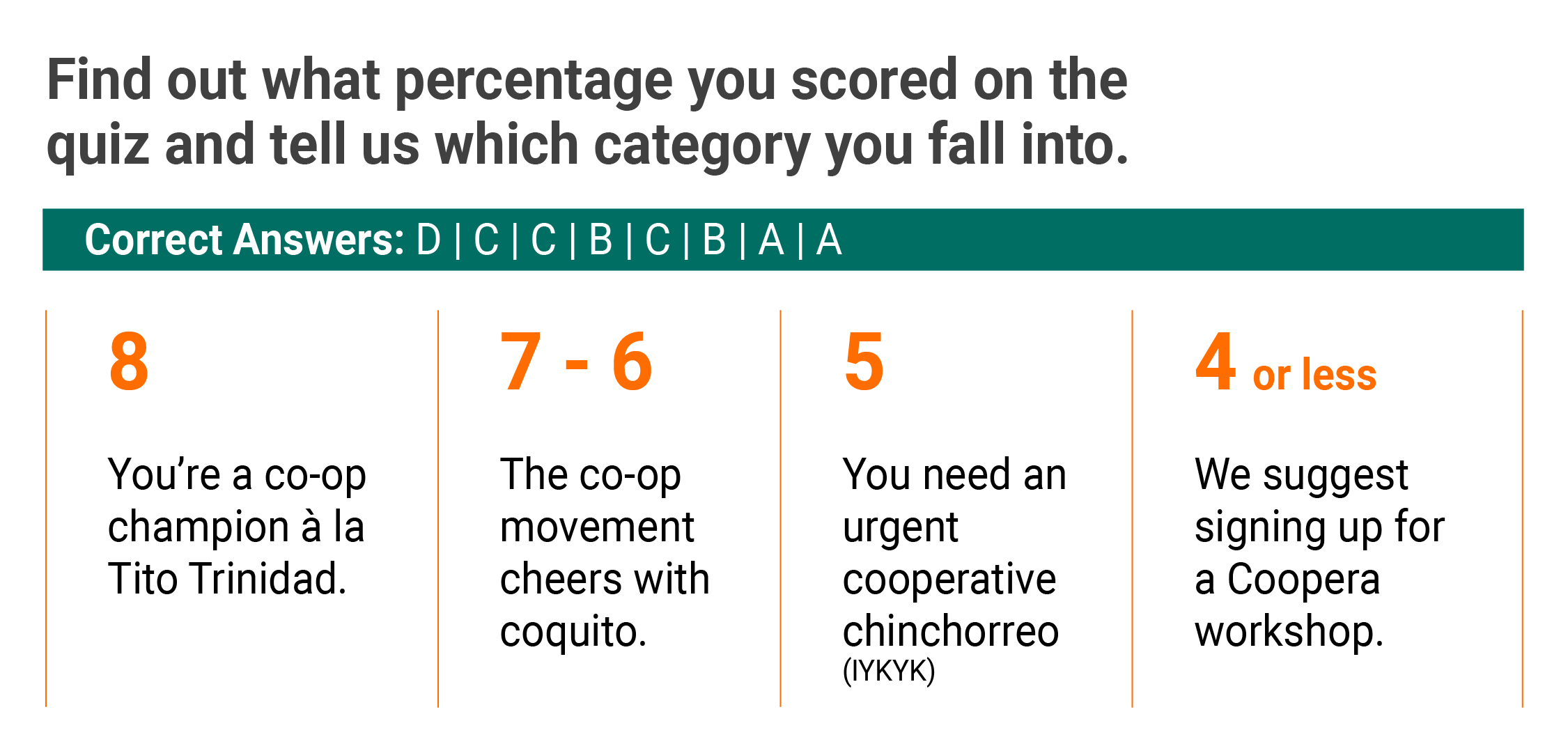
Perhaps some of the answers surprised you. And that is precisely the point.
Puerto Rican cooperativism isn’t limited to the walls of a credit union. It can also be found in the coffee we drink, the food we buy, our housing, the professional services we hire, a bicycle, a school, or even a component used by the pharmaceutical industry.
When we begin to recognize these experiences, a much broader picture emerges: a cooperative network that spans economic activities, communities, and different ways of working, producing, and collectively meeting needs.
So, how cooperative is the Puerto Rico you know?

The authors are members of CoopERA, a cooperative that offers educational services on cooperativism, facilitates spaces for collective work, provides organizational consulting, and conducts socioeconomic studies.
You can read the Analysis of Diverse Types of Cooperatives in Puerto Rico here.