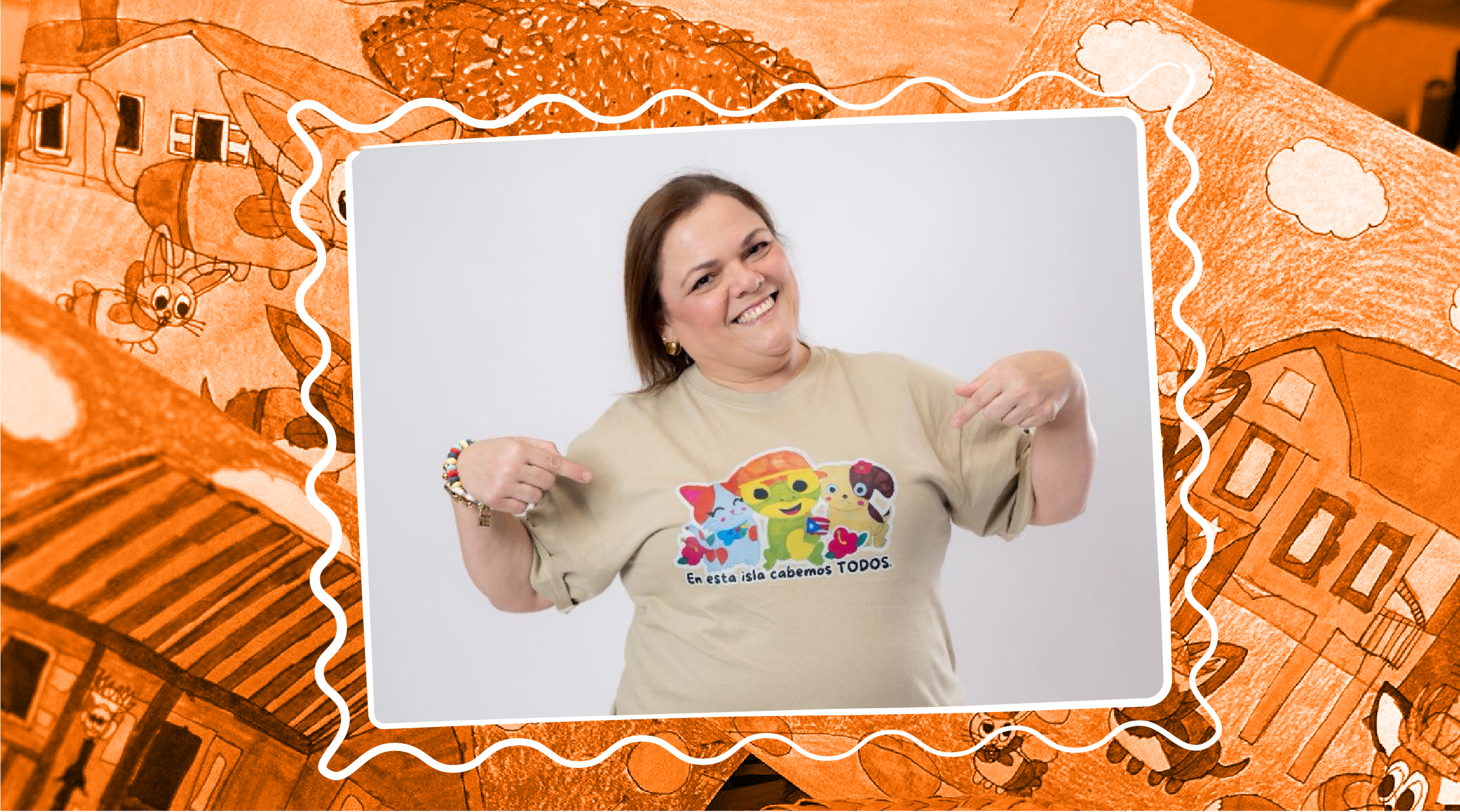
Lizania Alvarado Mercado: “It’s up to me to show the world how my daughter learns”
The co-founder of Los Dibujitos de Denise explains how her company supports the social and economic development of her daughter, who has autism
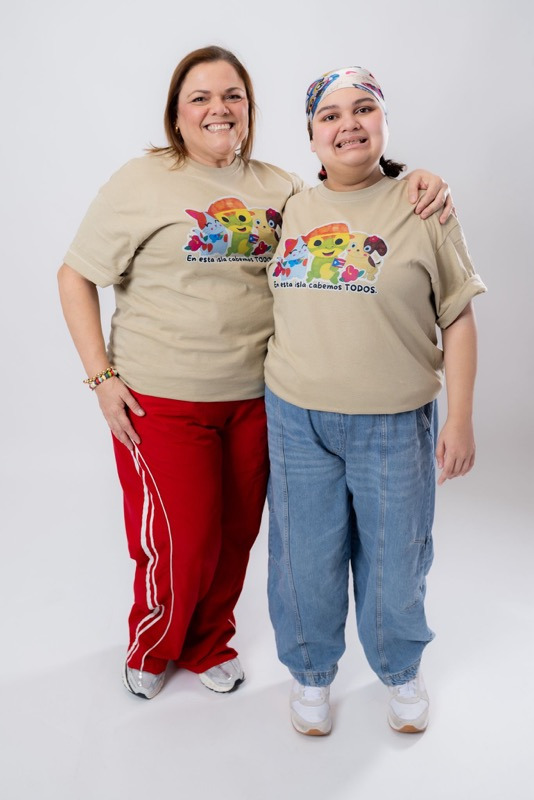
A sticker of a coquí frog wearing a straw hat, a scarf filled with animal drawings, and a necklace featuring the autism puzzle on a heart-shaped pendant. These are some of the items on display at one of the tables at the fifth edition of Autism Expo at the San Juan Department of Recreation and Sports. A customer approaches the table and asks Lizania Alvarado Mercado how much the scarves and lanyards cost. She buys two lanyards with animal designs and the artist’s signature: Denise Joaliz. Los Dibujitos de Denise (Spanish for Denise’s Little Drawings) is a family business that sells merchandise designed by the artist: an 18-year-old woman with autism.
Alvarado Mercado, the company’s co-founder and Denise’s mother, told 9 Millones that, when Denise was two years old, she still wasn’t speaking, so they began conducting evaluations. At age three, she received a formal diagnosis.
“Unlike many people, I didn’t feel a sense of grief or frustration at the time,” she recalled, noting that she immediately asked the doctor what steps to take.
Over the years, the family realized that Denise not only loved to draw, but also used drawing as a way to communicate.
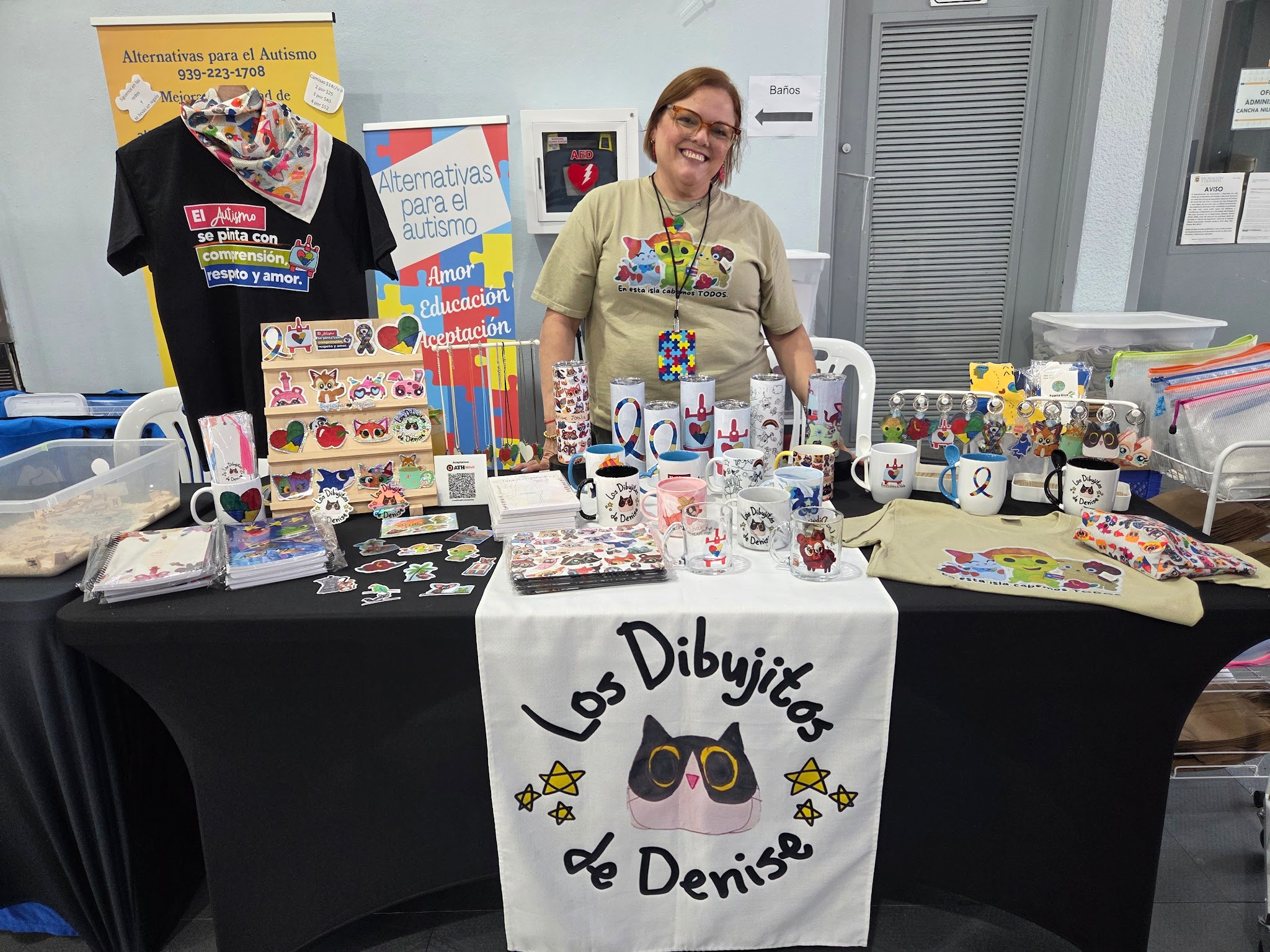
“These spaces for self-regulation are very important for children with autism, and art has always been the place where she can regulate herself; it helps her calm down,” explained Alvarado, who co-founded the company with her niece, graphic designer Gabriela Vélez. Los Dibujitos de Denise has been raising awareness about autism in Puerto Rico and supporting Denise’s economic and social development for five years now.
During this Mother’s Day week, 9 Millones interviewed two mothers of artists to highlight how raising children could be both a life and a nation-building project. The responses have been copyedited for brevity and clarity.
Camille Padilla Dalmau: How did you discover Denise’s love for art?
Lizania Alvarado: I never thought that my daughter could even draw. Denise didn’t communicate at all. On this journey, it’s really important to figure out how they can learn and communicate. That’s where the drawings come into play. Denise started drawing in her notebooks and sketchbooks. A little dog… a little cat. If she was sleepy, she’d draw me a little cat and write “zzzzz”—meaning she was sleepy. We saw that she was, in fact, beginning to understand her surroundings, but it was through drawing that she could express herself.
I never imagined that this simple way of communicating would turn into all this. I have to confess that when we started “Los Dibujitos,” it wasn’t our intention to make it a business. What we wanted was to have a workshop for Denise—to show her and teach her about work skills, money management, and responsibility. It was more therapeutic. And social media is wonderful. When people started sharing and embraced Denise's style of drawing—simple, yet colorful and cheerful—we realized that beyond having a project for Denise, we could make a difference for others like her who need to be seen.
Camille: Does the company help support Denise?
Lizania: Our mission is to build a financial safety net—that economic foundation for Denise. I won’t be around forever. As harsh and painful as that may sound, there will come a time when I won’t be by Denise’s side, but we intend for this brand to keep going.
Camille: How does the brand raise awareness about autism?
Lizania: Other brands have used Denise's drawings to raise awareness about autism. [In 2024, McDonald’s released a series of Christmas cups featuring Denise’s drawings]. So, when I have to introduce Denise to people and show them what she’s like—how she learns, how she communicates—people start to understand that autism isn’t just about the genius, the gifted child, or the one who talks a lot; but also the person who doesn’t communicate verbally, the one bothered by noise, the one who needs silence, the one who needs their space—and this has helped us keep educating the public so they know the spectrum isn’t just one side, but [that] it’s broad. People with autism or families who are impacted—just like us, at this level of autism—thank us. They tell us: “Thank you, Mom” or “Thanks to your family for raising awareness about the needs of these young people and helping them to integrate into society.”

Camille: What would you like other people to understand about people with disabilities?
Lizania: Not everything can be tailored to those of us who don’t have any special needs. We need to start letting go of that individualism a little bit. She needs to belong. She needs her space. Why can’t she go to a theater, to a restaurant? Why can’t she go to a park, and have that environment adapted for her as well? Those of us who are neurotypical aren’t the only ones who exist in society; there are also people with some type of neurodivergence, who also need to go out and socialize, but they need an adapted environment.
We’re helping Denise belong to this society and adapt, but in the case of my daughter and other young people, they need help from those around them—to let go of their selfishness a little and include them too. That’s what is seriously lacking.

Camille: What has raising Denise taught you?
Lizania: We were raised in a very structured way. Whatever Mom and Dad said was what we had to do, whenever they said so.
What have I learned from Denise? That it’s on Denise’s time—not mine, and not society’s.
Denise learns differently; it’s not that she won’t learn, but the environment needs to be adapted. This has taught me that I have to pay much closer attention to what my daughter needs in order to be happy: What does she like? What doesn’t she like? What bothers her? What makes her uncomfortable? What overwhelms her? What doesn’t overwhelm her? [I’ve had to] start listening to her “yes” and her “no.” We were often told [as children], “Yes, because I said so.” In Denise’s case, when she says “no,” I have to listen to why she’s telling me that; what might have caused her not to want to go to that place. That’s the difference between how I was raised and how I raise Denise. It’s very different, because it’s focused on my daughter’s needs.
There’s a phrase I heard around four years ago: “Parents are supposed to teach our children about the world, how the world works.”It’s up to me to show the world how my daughter learns.
The author is a journalist, educator, and founder of 9 Millones.